
Quantifying the Dual Drivers (Crypto Mining & AI Storage Demand) on the Same Index Constituents
There is a curious overlap emerging in modern infrastructure: the same companies that once existed purely to mine cryptocurrencies are now being courted as potential providers of AI storage and computing power. Power-hungry bitcoin miners are repackaging themselves as high-performance computing (HPC) and AI infrastructure platforms, offering energy, cooling and rack space to both blockchains and machine learning workloads. For index designers and ETF investors, that creates a challenge and an opportunity: how do you quantify the dual drivers of crypto mining and AI storage demand acting on the same constituents?

This post explores that question with a flexible lens. We will move between the quantitative and the narrative, between tech economics and portfolio mechanics. Rather than pinning down a single formula, we will sketch an approach: how to think about dual drivers, how to reflect them in indices and derivatives, and how to navigate the changing profile of companies that straddle both crypto and AI.
Shared Infrastructure, Divergent Business Models
Cryptocurrency mining and AI storage both rely on intense, continuous computing workloads. They require large amounts of power, cooling, physical space and connectivity. Yet the revenue models differ sharply. Crypto miners earn block rewards and transaction fees, denominated in volatile tokens. AI infrastructure operators earn contracted payments from tenants, often under multi-year agreements tied to data center capacity, storage and compute services.
When the same company participates in both worlds, its equity profile becomes hybrid. Its earnings and valuation respond to:
- Crypto price cycles and network economics.
- AI demand for storage, high-bandwidth memory and compute capacity.
- Power market dynamics, grid access and regulatory constraints.
An index that includes these names can no longer be described as purely “crypto” or purely “AI infrastructure.” It is shaped by both, and ETF and derivative strategies built on that index inherit the dual sensitivity.
Identifying Dual-Driven Constituents

The first step in quantifying dual drivers is identifying which companies in an index are truly exposed to both crypto mining and AI storage/computing demand. Not every data center operator mines bitcoin, and not every miner has pivoted to AI workloads. You can think of dual-driven constituents as those where:
- Crypto mining infrastructure (ASICs, racks, cooling, transformers) is already deployed at scale.
- The company is actively investing in or marketing HPC/AI hosting, colocation or “compute as a service.”
- Revenue or capacity forecasts show meaningful contributions from both segments over the next few years.
Recent market developments show several publicly listed miners transitioning toward AI and HPC as a second or even primary pillar of their business models. In an index that tracks “digital infrastructure,” these dual-driven names become key nodes where crypto and AI demand intersect.
Two Demand Curves, One Equity Line
Conceptually, each dual-driven company has two overlaying demand curves:
- A crypto curve, driven by token prices, network difficulty, halving events and regulatory sentiment.
- An AI/storage curve, driven by model training demand, inference workloads, data center expansion and storage-class memory adoption.
The equity price and index contribution of the company reflect the blend of these curves. At times, crypto dominates; at other times, AI infrastructure becomes the main story. Quantifying dual drivers means separating these influences enough to see how each contributes to the index’s behavior, even though they ultimately recombine in a single price series.
Building A Dual-Driver Attribution Framework
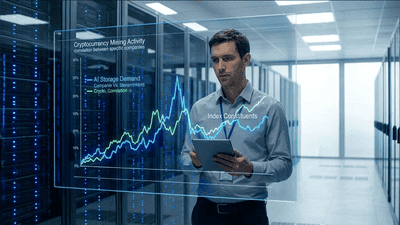
One flexible way to approach this is through an attribution framework. Instead of demanding precise causal decomposition, you aim for directional clarity: when the index moves, how much of that move can reasonably be linked to crypto variables versus AI/storage variables?
A sketch of such a framework might include:
- Factor identification: Choose proxies for crypto demand (bitcoin price, network hash rate, miner margin indices) and AI storage demand (data center capex indices, AI chip shipments, storage capacity deployments).
- Elasticity estimation: For each dual-driven constituent, estimate how sensitive its revenue or equity price is to changes in these proxies (for example, how much earnings move when bitcoin price doubles versus when AI hosting capacity doubles).
- Weighted contribution: Use index weights and estimated elasticities to infer how much the index’s movement over a period is attributable to each driver.
This does not need to be overly rigid. Even loosely estimated elasticities can give investors a useful sense of whether recent index moves have been “crypto-driven,” “AI-driven” or “mixed,” which in turn can guide ETF positioning and derivative strategies.
Case Feel: A Miner Pivoting To AI Infrastructure
Consider a stylized example of a constituent originally listed as a bitcoin miner. Its initial business is almost entirely crypto-dependent. Over time, its filings and guidance start to emphasize a pivot toward AI and HPC workloads: building dedicated data centers, signing contracts with AI tenants, and reallocating some power capacity away from pure mining.
In early years, the company’s equity price closely tracks bitcoin cycles. An index with this name behaves like a levered proxy on crypto. As AI hosting revenue grows, however, the linkage changes. Sensitivity to bitcoin price moderates; sensitivity to AI demand and data center metrics rises. For the index:
- Crypto beta declines but remains non-zero.
- AI/HPC beta increases, making the index more correlated with AI infrastructure benchmarks.
- The dual-driver nature becomes visible in cross-market co-movements.
Quantifying this evolution — by tracking how earnings and market cap dependence on each segment change — allows index providers and ETF users to adjust their narratives: from “crypto miner basket” to “dual-use power and compute infrastructure,” and eventually perhaps to “AI-first infrastructure that still monetizes crypto when favorable.”
Dual Drivers In Index Design: Weighting And Classification

Index designers face classification choices when dealing with dual-driven constituents. Do you label a pivoting miner as “crypto,” “data center,” “AI infrastructure” or some blend? Classification has consequences:
- Sector buckets: Index sector weights change depending on where dual-driven names sit.
- Thematic purity: An AI storage and computing power index may include miners if their AI exposure is substantial, but that can introduce crypto sensitivity.
- Weight caps: To avoid over-concentration in volatile dual-driven names, some indices may cap their weights or use modified weighting schemes.
Quantifying dual drivers helps make these choices explicit. If a constituent’s revenue is 70% AI hosting and 30% crypto, an AI infrastructure index might justify including it with a certain weight, acknowledging residual crypto influence. If the mix is reversed, inclusion might only make sense in a hybrid or “digital infrastructure” index.
ETF Behavior: How Dual Drivers Show Up In Practice
For ETF investors, dual drivers manifest as mixed behavior patterns. An ETF that holds both traditional memory manufacturers and pivoting miners might:
- Rally when crypto prices surge, even if AI demand is flat.
- Gain slowly but steadily when AI storage demand rises while crypto markets drift.
- Exhibit unusual volatility when both drivers swing in opposing directions.
Understanding this blend is important before using such ETFs as pure AI storage proxies. Quantitative attribution, using the dual-driver framework, can reveal what portion of the ETF’s volatility and returns are coming from crypto versus AI. That in turn informs whether the product fits a given portfolio role: core AI infrastructure, tactical crypto overlay, or a hybrid bet on energy-intensive digital workloads.
Index Derivatives: Expressing Views On Each Driver
Index derivatives — futures, options, swaps — add another layer. They allow investors to separate or recombine exposures in more targeted ways:
- Driver-specific overlays: Go long the AI storage index via futures while hedging crypto exposure through separate crypto index shorts.
- Spread trades: Trade the spread between a pure crypto miner index and a broader AI infrastructure index, implicitly betting on the relative strength of each driver.
- Options on dual-driven ETFs: Use options to express views on how dual drivers will interact — for example, buying calls when both crypto and AI demand are expected to strengthen, or protective puts when one driver is likely to weaken.
Quantifying dual drivers through elasticity estimates, correlations and scenario analysis helps inform strike selection, maturities and sizing for these derivatives. It moves trading away from vague “this feels strong” intuition toward structured exposure choices.
Energy And Grid Access: The Hidden Third Driver
Beneath both crypto mining and AI storage sits a shared constraint: energy. Access to grid capacity, long-term power contracts and efficient cooling systems has increasingly become a core asset in itself. Some analyses even treat “energized power” — megawatts ready to be deployed — as the primary metric for valuing dual-use infrastructure providers.
In practice, this means:
- Crypto and AI workloads compete for the same power and cooling resources.
- Companies that can flex capacity between these workloads have operational options: mine more crypto when prices are high, host more AI when demand surges.
- Indices and ETFs that include such names indirectly embed an energy-asset theme alongside crypto and AI.
Quantifying dual drivers, therefore, benefits from including a third dimension: how power capacity and grid relationships shape the mix between crypto and AI usage, and how that mix affects financial performance. Power is not just an input cost; it is part of the value proposition and an axis of differentiation.
Modeling Scenarios: Crypto Up, AI Down — And Vice Versa
One of the most useful applications of a dual-driver framework is scenario modeling. Rather than hoping both crypto and AI move in harmony, you explicitly ask: what happens when they diverge?
Consider four stylized scenarios:
- Crypto up, AI flat: Dual-driven stocks behave more like classic miners; indices with heavy exposure see cyclical spikes tied to token prices.
- AI up, crypto flat: Hosting and storage revenue grows; miners reposition as AI infrastructure; index behavior tilts toward data center and AI benchmarks.
- Crypto down, AI up: Companies with strong AI hosting pivot more aggressively; equity profiles shift away from pure miner beta toward infrastructure beta.
- Both up or both down: Dual drivers reinforce each other, either in rally phases or stress phases, leading to amplified moves.
Quantification involves assigning rough sensitivities and probabilities to each scenario for a given index. ETF investors and derivative traders can then plan: which structures perform best where, and how to adjust as real-world data reveal which scenario is unfolding.
Data Limitations And The Need For Flexibility
All of this talk of elasticities and attribution comes with a caveat: real-world data for dual-driven constituents can be messy. Revenue segments may be reported in coarse categories, AI hosting may be small but fast-growing, and crypto mining economics can change rapidly with network conditions and regulation.
A flexible approach acknowledges:
- Estimates will have uncertainty; they are best used to frame ranges rather than precise numbers.
- Drivers can change over time; a company that is 80% crypto today might be 50% AI hosting in two years.
- Indexes can lag structural change; periodic rebalancing is needed to keep index composition aligned with actual drivers.
The goal is not to build a perfect model, but to avoid treating dual-driven constituents as one-dimensional. Even rough quantification reduces blind spots.
Implications For AI Storage And Computing Power Themes
AI storage and computing power is an increasingly prominent theme, with dedicated indices, ETFs and structured products tracking data centers, memory, networking and accelerators. The presence of dual-driven names — miners pivoting to AI, hybrid infrastructure providers — complicates the theme but also enriches it.
For thematic investors:
- Dual-driven exposure can enhance returns when both drivers are supportive, but it increases cross-cyclical risk.
- Pure-play memory or storage indices may behave differently from hybrid “digital power” indices that mix miners and AI hosts.
- Understanding which ETFs lean heavily on dual-driven names helps match products to desired risk profiles.
Quantifying dual drivers makes it easier to position within the theme: you can choose whether you want mostly AI demand exposure, a blend with crypto sensitivity, or a more energy-centric infrastructure tilt.
Closing Reflections: Measuring A Moving Target
Quantifying the dual drivers of crypto mining and AI storage demand on the same index constituents is, by nature, a moving target. Companies evolve, revenue mixes change, and market narratives shift. Yet the exercise is valuable precisely because it pushes us to see beyond labels. “Miner” can mean “future AI host”; “AI data center” can mean “former crypto operation with retooled capacity.”
By mapping crypto and AI drivers, considering power as a third axis and using index derivatives to tune exposures, investors gain a more nuanced grip on a complex landscape. They can avoid the trap of treating hybrid infrastructure companies as if they only lived in one world. And they can design and trade ETFs and indices that acknowledge the overlapping realities of tokens, tensors and terawatts — without insisting on rigid boundaries in a market where boundaries are actively being redrawn.
You May Like

Narrowing Spread Between NAND Spot and Contract Prices in 2026 – A Signal
By 2026, one of the most watched metrics in the NAND flash market has started to shift in a subtle but meaningful way: the spread between spot prices and long‑term contract prices is narrowing. For casual observers, this may look like just another incremental change in a notoriously volatile industry. For memory makers, module houses, device OEMs, and data center buyers, however, a tightening gap between spot and contract prices is a signal—a reflection of evolving supply–demand balance, risk perceptions, and strategic behavior on both sides of the market.

Price Divergence Trading Strategies Between NAND Flash and DRAM ETFs
NAND flash and DRAM sit at the core of AI storage and computing power. Both are memory, but they are not the same business. DRAM is main memory—fast, volatile, and central to high‑bandwidth workloads like AI training and inference. NAND is non‑volatile storage—slower than DRAM, but crucial to persistent data and large‑scale object storage. The cycles that drive their pricing and margins overlap, yet they often diverge. That divergence is where trading strategies between NAND and DRAM ETFs become interesting.

China’s HBM Localization Progress: The Catch-Up Pace of CXMT and XMC
China’s drive to localize advanced memory technologies has accelerated over the past several years. High-Bandwidth Memory (HBM) sits near the center of that strategy because it is integral to AI accelerators, high-performance computing (HPC) and other strategic compute platforms. Two domestic players—ChangXin Memory Technologies (CXMT) and XMC (Xianghui Memory, commonly referred to as XMC)—have become focal points in assessing how quickly China can close the gap with international incumbents on HBM die, stacking, and packaging.

Thermal Simulation Challenges and Solutions in 3DIC AI Chip Design
As AI workloads push chips to deliver ever higher compute density, designers are increasingly turning to three‑dimensional integration (3DIC) to stack dies vertically and pack more functionality into limited footprints. While 3DIC architectures unlock significant performance and bandwidth advantages, they also introduce complex thermal behaviors that are far harder to predict and manage than in traditional 2D layouts.
An Attempt at Compiling a Memory+Compute Fusion Thematic Index – A Dual-Track Framework
Most AI investors talk about “compute” as if it were the whole story: GPUs, accelerators, chips, cores. But every one of those cores needs somewhere to read from and write to. Memory and storage define how wide the data highway really is. In practice, AI performance is a fusion of compute and memory, not a solo act. So why do so many indices and ETFs separate them into different silos—one for semiconductors, one for memory, one for data centers—when the actual workloads keep blending them?

Surging Demand for Laser Drilling and Plasma Dicing Equipment in Advanced Packaging
Advanced packaging has become one of the semiconductor industry’s most important growth engines, and it is now pulling a surprising set of process tools into the spotlight. Among the most in-demand are laser drilling and plasma dicing equipment. These machines sit close to the heart of heterogeneous integration, fan-out packaging, wafer thinning, TSV formation, glass substrate processing, and other advanced flows where precision, yield, and throughput matter enormously. As packaging moves from a back-end afterthought to a strategic platform, the equipment used to shape, open, and separate materials has become just as important as the dies themselves.
D2D Interface Bandwidth and Latency Comparison in Chiplet Architectures
Chiplet architecture has turned the package into a real performance battleground. Once multiple dies are placed side by side or stacked within the same advanced package, the quality of the die-to-die, or D2D, interface becomes one of the most important determinants of system behavior. Bandwidth is no longer a nice-to-have metric, and latency is no longer a small implementation detail. Together, they shape whether a chiplet system feels nearly monolithic or frustratingly fragmented.

Stock Selection Logic and Alpha Validation of ESG-Themed Semi ETFs
Semiconductor themed ETFs are no longer just about growth and cycles. A growing subset now layers environmental, social, and governance (ESG) criteria on top of traditional sector exposure. These ESG semi ETFs promise two things at once: access to one of the market’s most powerful secular themes, and alignment with sustainability and governance standards. The pitch is appealing, but it raises two hard questions. First, how exactly are these stocks being selected? Second, does the ESG overlay help, hurt, or leave alpha unchanged?